
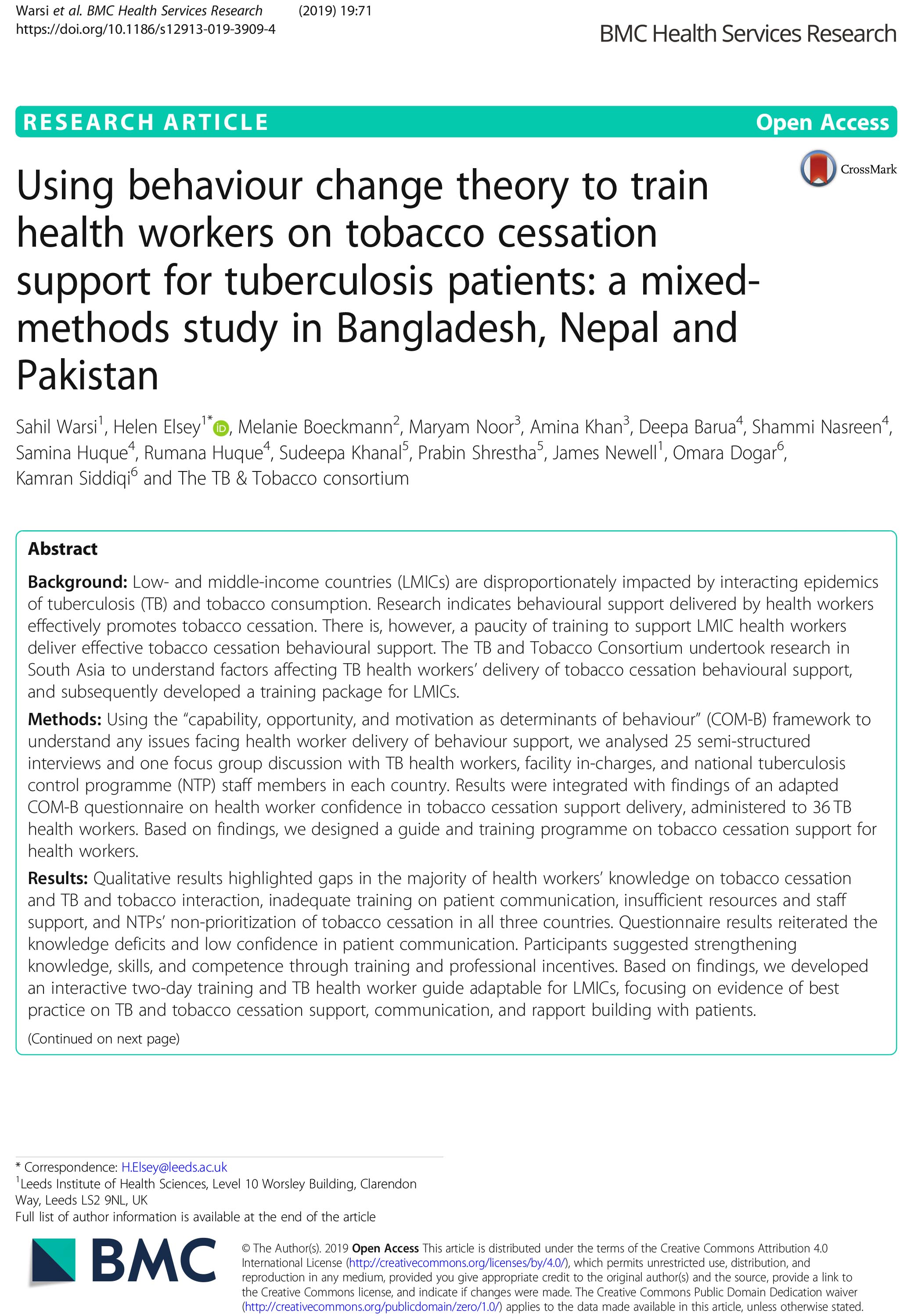
The research paper "Using Behaviour Change Theory to Train Health Workers on Tobacco Cessation Support for Tuberculosis Patients" explores the effectiveness of training TB health workers in Bangladesh, Nepal, and Pakistan to provide tobacco cessation support. Using the COM-B (Capability, Opportunity, Motivation – Behaviour) framework, the study identifies key challenges in integrating tobacco cessation into routine TB care, including health workers' limited knowledge, inadequate patient communication skills, and lack of institutional support. Through semi-structured interviews, focus groups, and questionnaires, the research highlights the need for structured training to strengthen health workers' confidence and competence. Based on these findings, the study develops an interactive, two-day training program and a health worker guide, emphasizing evidence-based tobacco cessation strategies, patient counseling techniques, and behavioral support interventions. The results suggest that enhancing health workers' skills through structured training and institutional support can significantly improve tobacco cessation outcomes among TB patients, reinforcing the need for integrated tobacco control strategies in national TB programs across low- and middle-income countries.
