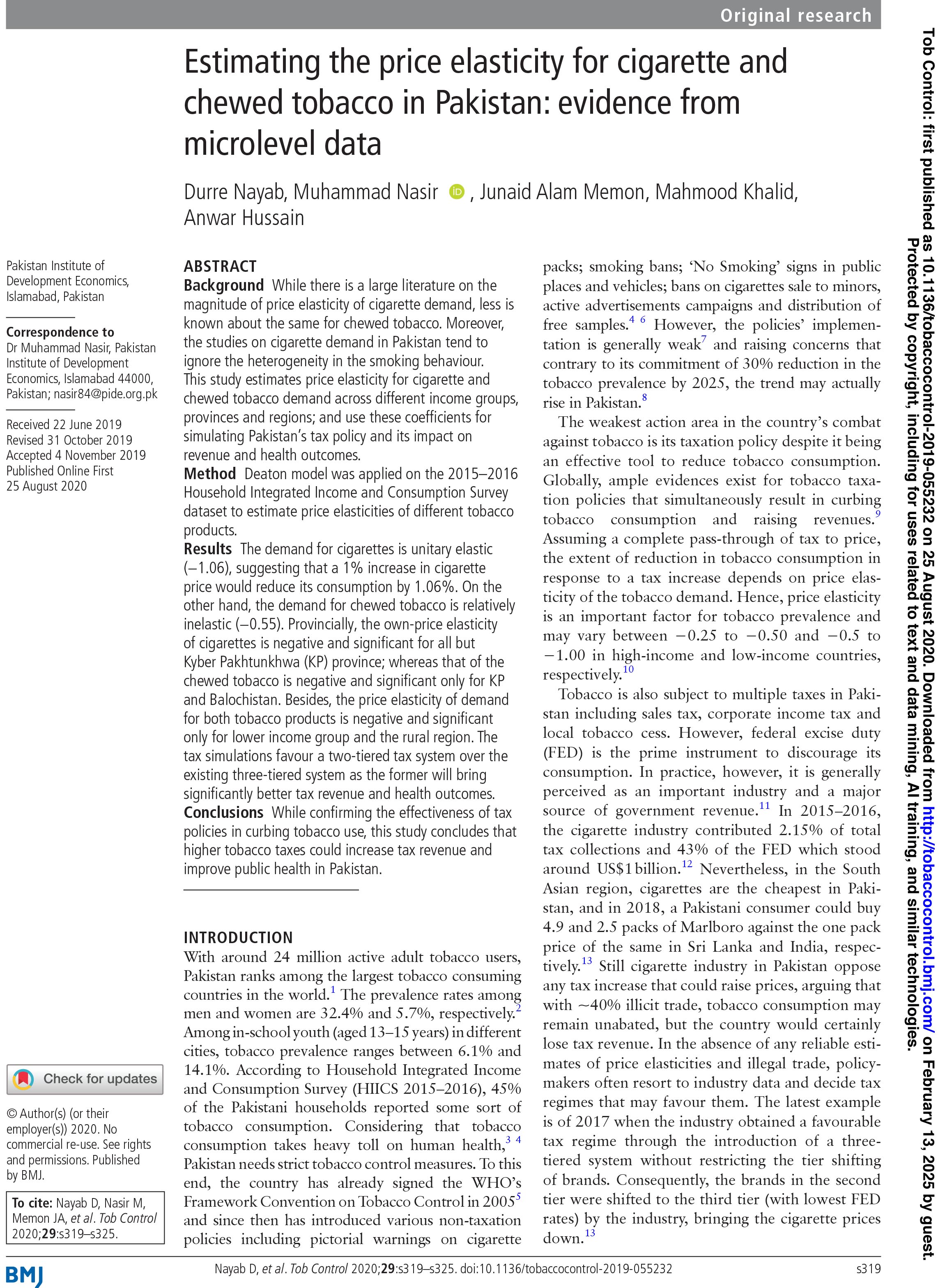
The research paper "Estimating the Price Elasticity for Cigarette and Chewed Tobacco in Pakistan: Evidence from Microlevel Data" examines the responsiveness of tobacco demand to price changes in Pakistan using household-level data. By applying the Deaton model to the 2015–2016 Household Integrated Income and Consumption Survey (HIICS), the study estimates that cigarette demand is unitary elastic (-1.06), meaning a 1% price increase leads to a 1.06% reduction in consumption, while chewed tobacco demand is relatively inelastic (-0.55), indicating a weaker response to price changes. The analysis reveals significant regional and income-based variations, with lower-income and rural populations being more sensitive to price increases compared to urban consumers. The study also conducts tax simulations, demonstrating that a two-tiered tax system would be more effective than the existing three-tiered system in increasing tax revenue while reducing smoking prevalence. The findings confirm that higher tobacco taxes can reduce consumption and improve public health, supporting stronger taxation policies as a tobacco control strategy in Pakistan.